
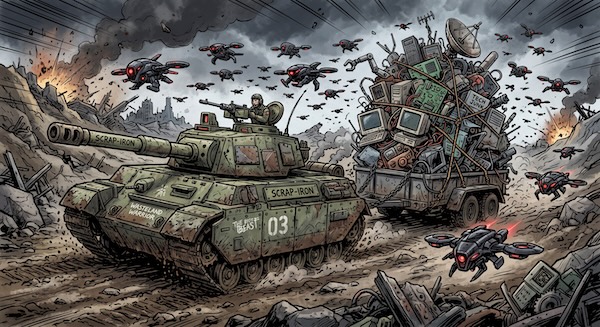
If you’ve been in cybersecurity long enough you remember the mantra of “defense in depth”. “Defense in depth” meant bigger firewalls, more appliances, and a thicker stack of tools protecting the data center. These days, in the age of AI, cybersecurity defense feels less like building a fortress and more like trying to drive a battle tank through a sky full of cheap, autonomous drones.
Here’s the thing, though: AI hasn’t actually rewritten the rules of cybersecurity. What it’s done is expose, brutally and quickly, all the places where we’ve been using tools and controls to paper over complexity and technical debt instead of fixing it. That distinction matters, and I think it changes what security leaders, IT leaders, Engineering leaders and their organizations should actually be doing in the era of AI.
The old playbook is showing its age
For decades, securing and enterprise followed what’s sometimes called a “Maginot Line” mindset: build a strong perimeter, add central choke points, stack up controls at the network edge, and trust that thickness would hold.
Then, over the last several years the industry shifted toward “identity is the new perimeter” and a general assumption that breach is inevitable — so detection and response deserve at least as much investment as prevention.
That shift was the right call. It’s just not finished. The G7 Cyber Expert Group — the group of technical advisors that briefs G7 finance ministries on cyber risk — put out a statement in October 2025 calling AI a “double-edged sword” for cybersecurity.
AI makes detection and response better, but it also makes attacks faster, bigger, and more damaging. The EU’s cybersecurity agency, ENISA, went a step further, calling 2025 “the first year in which AI fundamentally reshaped the cyber threat landscape” after analyzing nearly 4,900 tracked incidents.
Translation: a lot of us are still driving tanks into a fight that increasingly rewards swarms of cheap, software-defined drones.
Tanks and drones: an asymmetric warfare
Picture the typical enterprise security stack as a tank. It’s expensive. It’s heavily armored (firewalls, VPNs, EDR, DLP, WAFs, MFA, SIEM) and it’s built for predictable threats moving along known paths, the kind of thing MITRE’s ATT&CK framework has been cataloging for years.
Like most asymmetric fights, the attacker only has to be right once. The defender has to be right every time. Historically, defenders have had one real advantage: attackers rarely have complete knowledge of the target. But that edge shrinks fast once reconnaissance itself can be automated and run nonstop for pennies. That’s not a hypothetical anymore!
In 2025, Anthropic disclosed and disrupted what it describes as the first documented large-scale cyberattack carried out with substantial AI orchestration. An AI coding agent automated reconnaissance, harvested credentials, broke into victim networks, decided which stolen data was worth exfiltrating, and even drafted the extortion notes — targeting at least 17 organizations, with ransom demands sometimes topping $500,000. Anthropic’s own conclusion: “AI has lowered the barriers to sophisticated cybercrime.” People with limited technical skill are now running operations that used to take years to learn.
That’s not an isolated case, either. ENISA found state-linked groups from China, Iran, and North Korea using off-the-shelf commercial AI tools for reconnaissance and code generation, alongside a rise in purpose-built malicious AI tools designed specifically to dodge detection. The World Economic Forum’s 2026 Global Cybersecurity Outlook found that 29% of security leaders now name “advancing adversarial AI capability” as one of their top concerns.
So the asymmetry is real, and it’s mostly economic: defenders keep sinking money into expensive, hard-to-reconfigure tanks. Attackers field swarms of cheap, disposable software drones that keep learning.
The debt nobody wants to pay down
Here’s the uncomfortable part. A good chunk of the modern security stack doesn’t exist because the world got scarier — it exists because IT environments are complex and inherently undisciplined.
Every unmanaged SaaS app, every “temporary” firewall exception, every orphaned admin account or unpatched vulnerability is technical debt that piled up while the business was moving at an ever increasing speed. And the usual response wasn’t to pay that technical debt down — it was to bolt on another tool and hope more armor compensates for missing hygiene.
The numbers back this up. Verizon’s 2026 Data Breach Investigations Report found that exploiting unpatched vulnerabilities overtook credential theft as the single biggest way attackers get in — present in 31% of breaches.
And here’s the part that stings: the median time it takes organizations to patch a known, actively-exploited vulnerability actually got worse, rising from 32 days to 43 — a 34% increase, in the wrong direction, at exactly the moment attackers sped up.
AI doesn’t need to be clever to take advantage of that gap. It just needs to be fast, tireless, and cheap enough to run against every exposed asset you have, all the time. The problem was never only that attackers have drones. It’s that a lot of us have built infrastructure that’s genuinely fun for a drone to explore.
So why doesn’t anyone just clean up the debt? In my experience it’s rarely one reason — it’s usually several stacked on top of each other.
- Budget constraints: There’s no budget line for “figure out what that firewall rule from 2019 actually does”. Budget gets approved for new tools, not for unwinding old ones.
- No incentive: People rarely get a good performace review for decommissioning a legacy subnet, but they do for shipping the thing the business asked for.
- Complexity: Untangling years of exceptions and dependencies is genuinely hard, especially once the person who understood why a rule exists is no longer around.
- Fear: touching a brittle, undocumented system that’s technically “working” feels a lot riskier than leaving it alone, even when leaving it alone is the actual risk.
And underneath all of that, it’s honestly just a grind — unglamorous, invisible-when-done-well work that nobody will ever notice or thank you for.
What’s actually changing (and what isn’t)
Across all the government statements, agency reports, and industry research, one theme keeps showing up: AI is mostly an amplifier. It speeds up and scales up both sides of the fight. On defense, adoption is real: The World Economic Forum (WEF) found:
- 77% of organizations now use AI somewhere in their security operations.
- 52% for phishing detection
- 46% for intrusion and anomaly response
- 40% for behavioral analytics.
That’s meaningfully up from a couple of years ago.
But there’s also a governance gap that worries me. IBM and the Ponemon Institute’s 2025 breach research found that 97% of organizations that had an AI-related security incident lacked proper access controls on their AI systems, and 63% had no formal AI governance policy at all.
“Shadow AI” — tools nobody approved or is tracking — added an average of $670,000 to the cost of a breach where it showed up. WEF’s numbers tell the same story from a different angle: only 64% of organizations formally assess the security of the AI tools they actually use.
There’s also a genuinely new category of risk here: the AI systems themselves. NIST’s updated taxonomy and the OWASP Top 10 for LLM applications both describe attacks like prompt injection, data poisoning, and model theft — and MITRE’s ATLAS project now tracks dozens of techniques aimed specifically at AI pipelines. If you’re deploying AI without thinking about how it gets attacked, that’s a blind spot worth closing or you just keep adding debt to your already tall pile.
The real shift is speed, not sophistication
If there’s one place AI genuinely changes the game, it’s tempo. On the defensive side, IBM’s research found the global mean time to identify and contain a breach dropped to 241 days — the lowest in nine years — and tied that improvement directly to AI-powered defenses. Average breach costs fell 9%, from $4.88 million to $4.44 million, over the same period.
On the offense side, that same tempo shift is what made the Anthropic incident possible: one operator running an AI agent through reconnaissance, exploitation, and extortion across 17+ targets with minimal hands-on involvement. Processes built for human pace — ticket queues, monthly change boards, weekly patch windows — become liabilities the moment the other side is operating at machine speed.
Humans still matter enormously for setting risk appetite, handling ambiguity, and building the guardrails in the first place. But the day-to-day loop increasingly can’t wait on someone to click “approve.”
So what should we actually do about it
A few things, in rough priority order:
- Make technical debt visible. Tie architecture simplification and configuration hygiene to actual risk metrics instead of treating it as a background cleanup project nobody gets credit for.
- Fix your data before you buy more AI. Solid logging, accurate asset inventories, and clean identity signals matter more than model sophistication. Garbage in, garbage out still applies — no AI tool compensates for messy underlying data.
- Start AI where latency actually costs you money. Phishing detection, anomaly detection, alert triage, automated containment — these are the areas where the data already shows the clearest wins.
- Secure the AI itself. NIST’s taxonomy, OWASP’s LLM Top 10, MITRE ATLAS, and the joint CISA/NSA/NCSC secure-AI guidelines are all free, all current, and all worth reading before you deploy something.
- Close the governance gap. Given that 63% of organizations still have no AI governance policy, this might be the single highest-leverage, lowest-cost thing on this list.
Bigger tanks aren’t the answer
None of this means AI reinvented cybersecurity from scratch. The fundamentals — know what you have, minimize implicit trust, reduce your attack surface, design for resilience instead of perfect prevention — are the same ones that mattered in the 90s. What’s changed is the tolerance for getting them wrong, and the fact that we now have to secure the AI systems themselves with the same rigor as everything else.
The organizations that come out ahead won’t be the ones with the biggest tank. They’ll be the ones who simplified their terrain, built AI defenses they can actually trust, and learned to move at machine speed without losing the human judgment that got them this far.
Here’s the part I actually find hopeful, though. Go back to that list of reasons nobody pays down technical debt — no budget line, no incentive, genuine complexity, a healthy dose of fear, and a grind nobody wants to own. AI doesn’t fix the budget or the incentive problem, but it’s genuinely well-suited to the grind itself. That tedious, pattern-matching work at scale, is exactly what these tools are good at, and exactly the kind of thankless work that’s been sitting at the bottom of everyone’s backlog for years.
So maybe the most useful thing AI does for security isn’t the flashy stuff — the autonomous detection, the machine-speed response. Maybe it’s that, for the first time, we actually have a real shot at doing the boring work. Simplifying the terrain instead of just armoring it further.